Your Business Is a Second Craft
“The truth is, I had to work very hard to make it look easy.”
Roger Federer, Dartmouth Commencement, 2024
I was walking through a warehouse with the owner of a construction company.
There was tape on the floor, marking where each piece of equipment was supposed to be stacked and stored. Much of the equipment sat outside the lines. We stepped around it, and in places over it. He grimaced every time.
His company has grown by double digits for seven years running. By any measure, it’s a success.
As we walked, he listed the other problems. A few processes breaking down. Customers who were satisfied but no longer delighted. Two foremen who had left. A few cash flow surprises.
Each one was a small crack. But they were adding up.
I can see what we can build this business into. I don’t know if I’m what’s holding us back, or my team is. Or if it’s something else.
He is a builder, and a master at it. He also has a knack for attracting good people.
To tell you the truth, I loved building it. I don’t love running it now.
As we dug into the root cause together, everything traced back to the same place. He had mastered his first craft, which is building. He had never treated running the company as a second craft.
The Second Craft
Almost every founder has a first craft. Construction, medicine, law, software, food. It’s the work the company exists to do, and the founder is great at it. That’s why the company grows.
Then it gets big enough that the first craft can’t carry it alone. Running the business becomes a second craft, with six fundamentals of its own. A vision the whole leadership team shares. The right people in the right seats. A handful of numbers reviewed every week. Issues solved at the root. Core processes written down and followed. A rhythm of meetings and priorities that turns the plan into action.
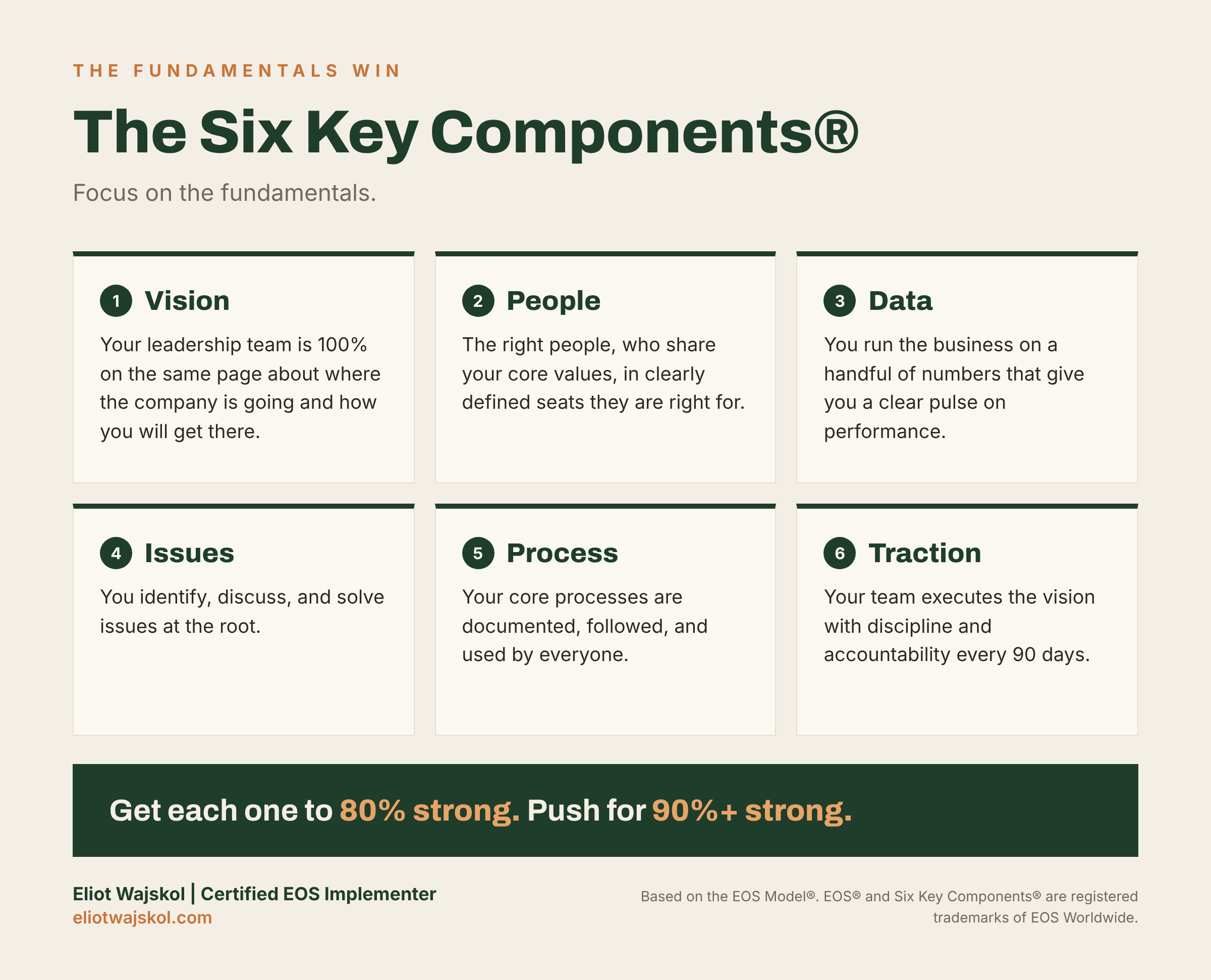
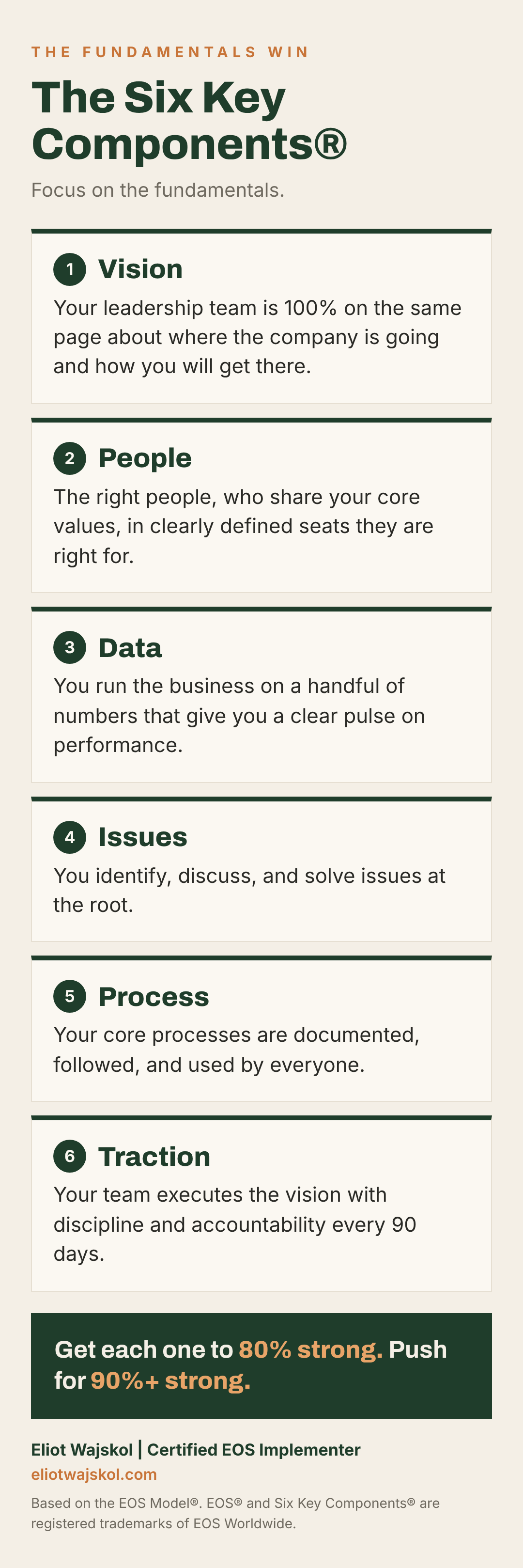
Every business has a hundred things competing for the owner’s attention. The reps belong on these six. I’ve watched that focus change company after company.
Most of his problems showed up as people problems. But none of his six fundamentals was at 80 percent strong, and they depend on each other. A weekly scorecard would have caught the cash flow surprises early. The same numbers would have shown which process was slipping and which seat wasn’t keeping up.
When one fundamental is weak, the others weaken with it.
None of it is complicated. Most of it is boring. That makes it easy to overlook.
Even When the Reps Are Boring
The best athletes in the world work the same way. They focus on the fundamentals.
Damian Lillard made 100,100 shots in the year he spent coming back from a torn Achilles. He is one of the best shooters the game has ever produced, and he tracked every make anyway.
Toni Nadal coached his nephew Rafa from childhood. “If you want to improve a shot in tennis, you have to practice it a thousand times. This can be brutally monotonous.”
Caitlin Clark credits her father for drilling her on form. “Make sure your form is always good. Then you can kind of always work your way back.”
John Wooden opened every season at UCLA by teaching his players how to put on their socks. He won ten national championships.
Every one of them put in thousands of reps on the right things. Most of those reps were boring. They kept coming back to the basics anyway, long after they had anything left to prove.
Most owners did exactly this in their first craft. They put their reps on the basics until the work became second nature. They never did it with the second craft, because nobody showed them where the reps belong.
Where Strong Teams Stall
Every craft is learned the same way. Japanese martial arts call it Shu Ha Ri. You learn the form and follow it exactly. You practice until it becomes yours. Then you understand it deeply enough to adapt it without breaking it.
Most teams stall at the first step. They run a few good meetings, build a scorecard and set priorities for a quarter. Then the business gets busy and the practice fades.
The companies that grow stay in practice, the way Lillard did. They hold the same meeting on the same day. They review the same numbers every week, including the weeks when the numbers are fine.
Where to Start
Try this. Rate your company on each of the six fundamentals, out of ten. Anything below eight is where your reps belong.
For a sharper read, have each member of your leadership team take the EOS Organizational Checkup on their own, then compare. Where your answers differ most is what your team isn’t talking about.
Start with the lowest one. Give it a full quarter of real practice before you move to the next.
When all six fundamentals are 80 percent strong, the business runs better. At 90 percent strong, it goes further than you planned.
Three questions:
Which of the six fundamentals have you never treated as something to get great at?
Which small cracks in your business are you treating as separate problems?
What did it take to master your first craft, and what would it look like to give the second one the same reps?
You’ve mastered one craft already. The business is the second.
The fundamentals win.